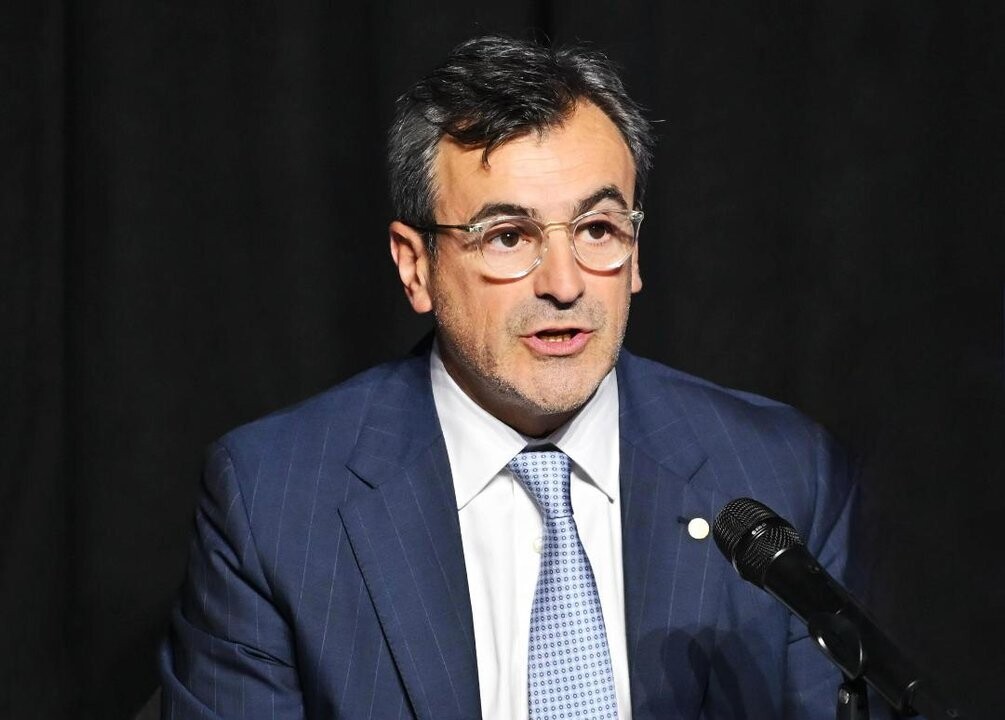
The president of the Argentine Industrial Union (UIA), Martín Rapalini, highlighted the need to generate employment and reduce litigation, while expressing concern about the slowdown in activity and competitiveness in a transitional year. Rapalini analyzed in depth the proposal for labor reform, the country's economic situation, and the prospects for inflation and the exchange rate for the coming year. He emphasized the urgency of modernizing the regulatory framework and reviving production. The businessman explained that the UIA and the Group of Six (UIA, CAC, CAME, Stock Exchange, ADEBA and the Rural Society) have worked over the last four months on projects aimed at employability and reducing 'strong litigation' in the country. The industrial leader pointed out that for 15 years 'registered employment has not been generated,' showing the depth of the labor problem. Regarding the position of the General Confederation of Labor (CGT), which described Minister Federico Sturzenegger's statements on the retroactivity of the reform as 'a frank confession,' Rapalini chose not to comment directly on the official. However, he reiterated that the reform seeks to change the functioning of litigation and modify the incentives that, in his opinion, are 'aimed at lawsuits or at not encouraging the productivity of companies.' He gave as an example vacations, where the law seeks to regulate practices already common in which workers and employers coordinate fragmented periods, something that 'happens in practice' but was not regulated. Rapalini acknowledged that litigation has been a 'constant concern' for the business sector, mentioning multi-million dollar lawsuits of '300, 500 million up to 1,000 million pesos' due to the application of fines and anathematism. He stressed the importance of changing this situation to foster a criterion of 'employability' in Argentina, highlighting the mandatory 3% contribution to a fund for termination compensation. The outlook for industrial activity Regarding industrial activity, the president of the UIA expressed 'very strong concern.' He described the first part of 2025 as a 'heterogeneous recovery,' which was abruptly halted from July due to the rise in interest rates. Martín Rapalini, president of the UIA. Addressing tax reform will be 'truly very complicated,' he added. He considers it 'a shortcut' to try to lower prices only by opening the economy to imported products without taxes. The priority must be to give the national producer 'the conditions to be able to compete,' with the industrial sector being 'part of the solution' and the protagonist of this new stage. What's coming for 2026 When asked about the end of the year and expectations for 2026, Rapalini described the current year as 'transitional.' According to Rapalini: 'The reform aims to generate employment and reduce a litigation that has become unsustainable.' The impact was 'much harder' in the least recovered sectors, where company closures or crisis prevention files are already being observed, as detailed by the leader.